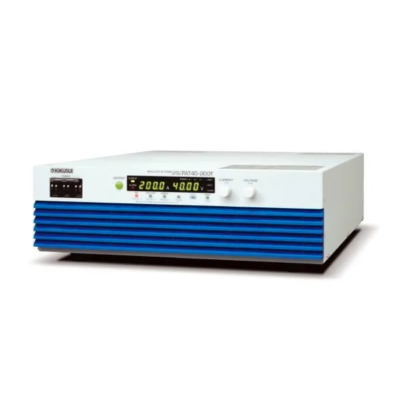
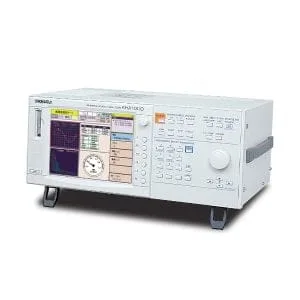
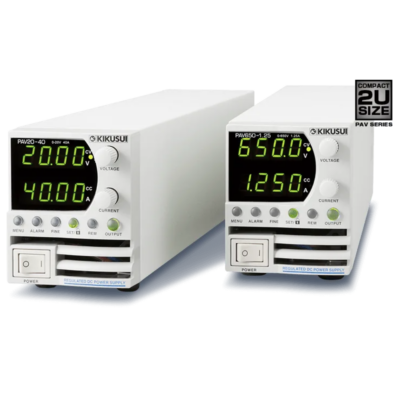
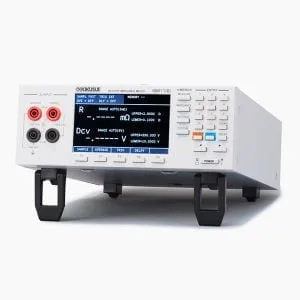
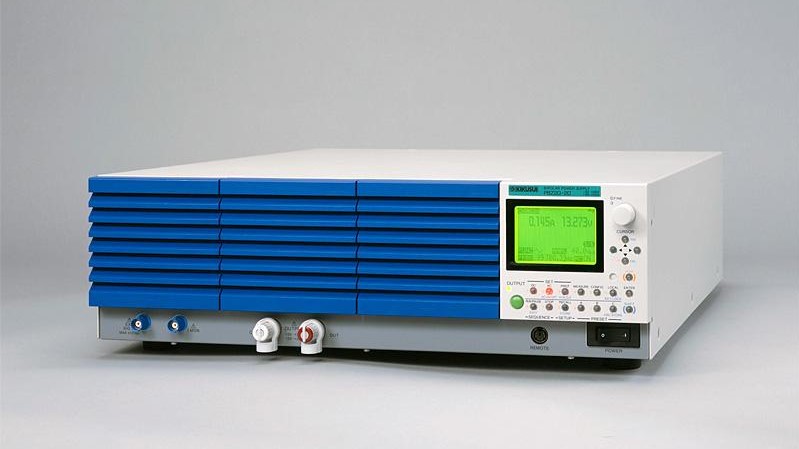
KIKUSUI PBZ Series Intelligent Bipolar Power Supply
Related Solution
Explore related EV inverter testing solutions
Review source, sink, and dynamic power approaches for traction inverter and EV power-electronics validation.

Related Solution
Review source, sink, and dynamic power approaches for traction inverter and EV power-electronics validation.
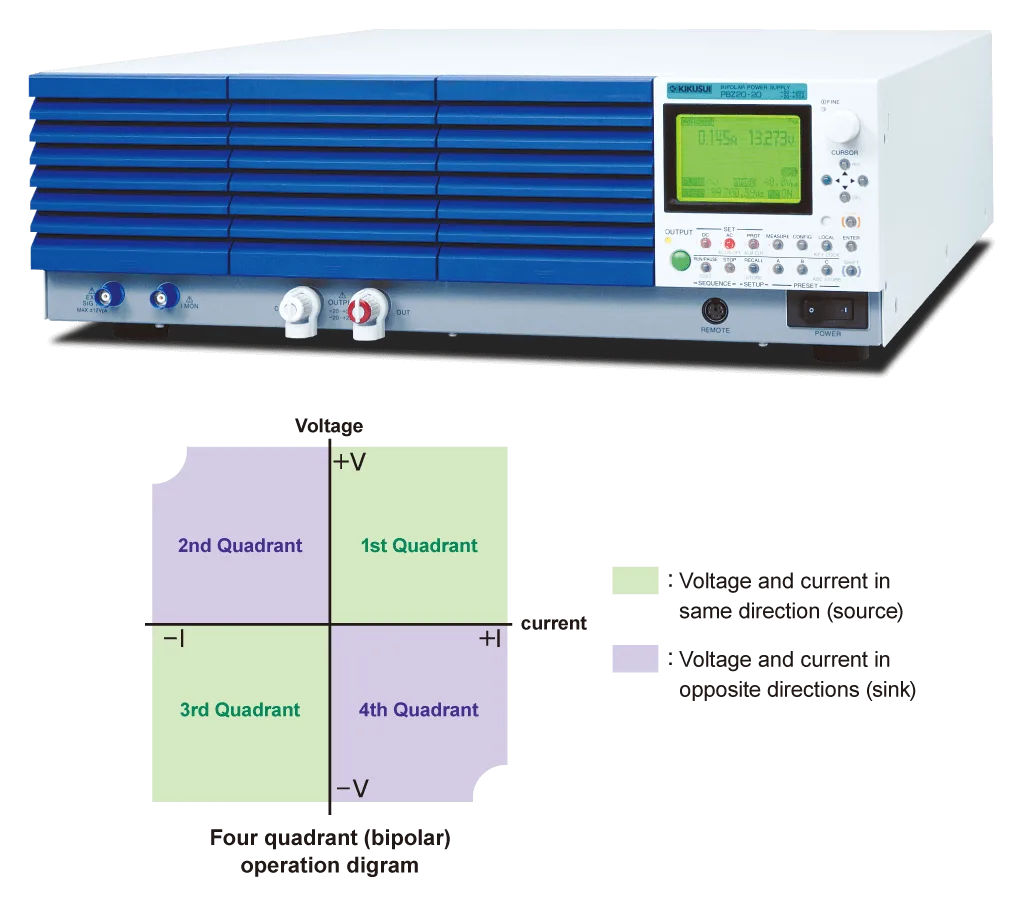
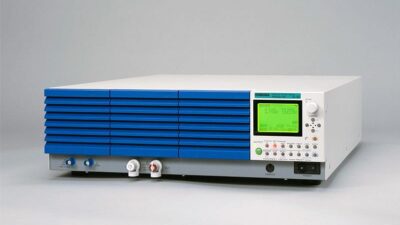
The KIKUSUI PBZ Series combines bipolar voltage and current output with four-quadrant source/sink operation, allowing the output to transition continuously through zero without changing output-terminal connections.
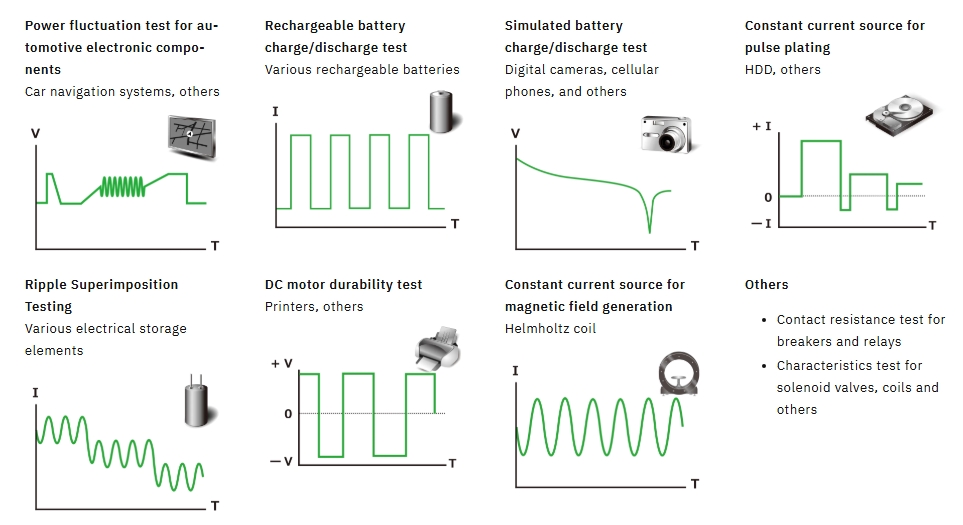
The series includes four standard models covering rated outputs from ±20 V / ±20 A through ±80 V / ±5 A. Built-in waveform generation and sequence functions allow the PBZ Series to reproduce dynamic voltage and current conditions without requiring a separate function generator for many test configurations.
Integrated voltage and current measurement, sequence programming, synchronization, remote sensing, and multiple communication interfaces make the PBZ Series suitable for both standalone laboratory testing and automated test systems.
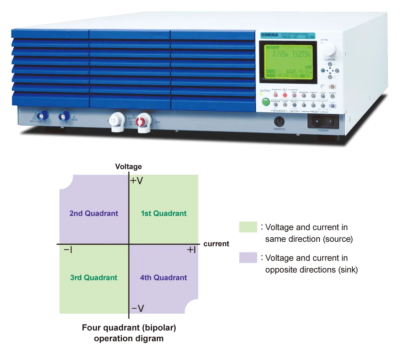
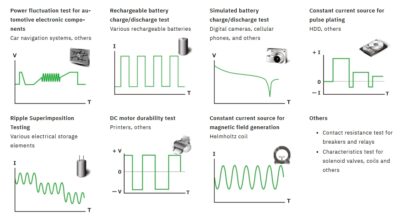
Bipolar operation allows positive and negative voltage and current to transition through zero without switching output-terminal polarity. The PBZ can operate as both a power source and a power sink.
The standard PBZ Series provides CV frequency response up to DC to 100 kHz, supporting rapidly changing voltage conditions and dynamic load testing.
Generate sine, square, and triangle waveforms as well as up to 16 user-defined arbitrary waveforms. Frequency, amplitude, phase, sweep, and square-wave duty parameters can be configured within the instrument.
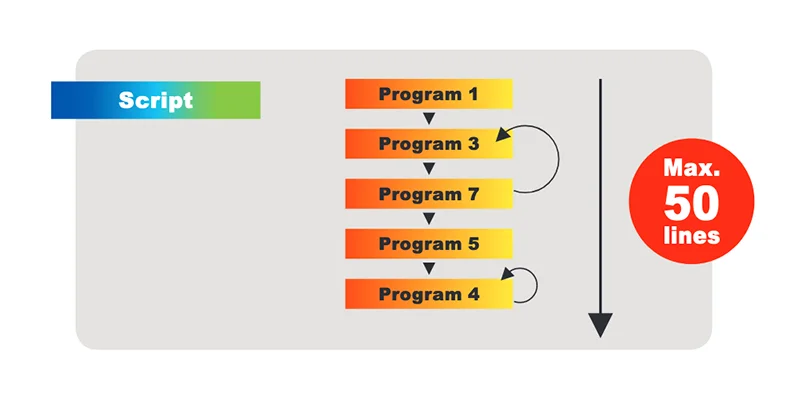
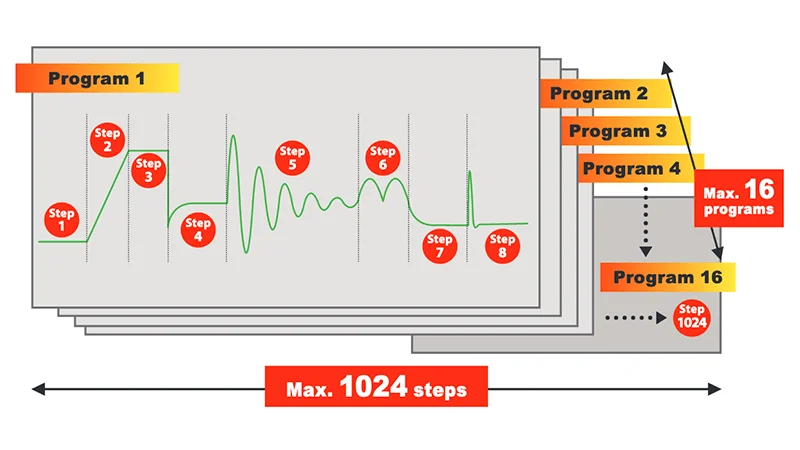
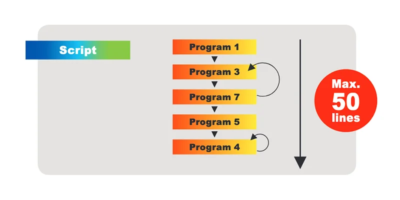
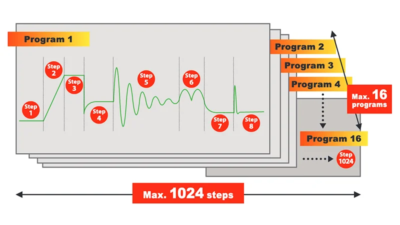
Create test sequences using up to 16 programs and a combined total of 1024 steps. Step times can be programmed from 100 µs to 1000 hours.
Measure voltage and current in DC, AC, DC+AC, and peak modes directly with the PBZ, reducing the need for separate monitoring instruments in many test configurations.
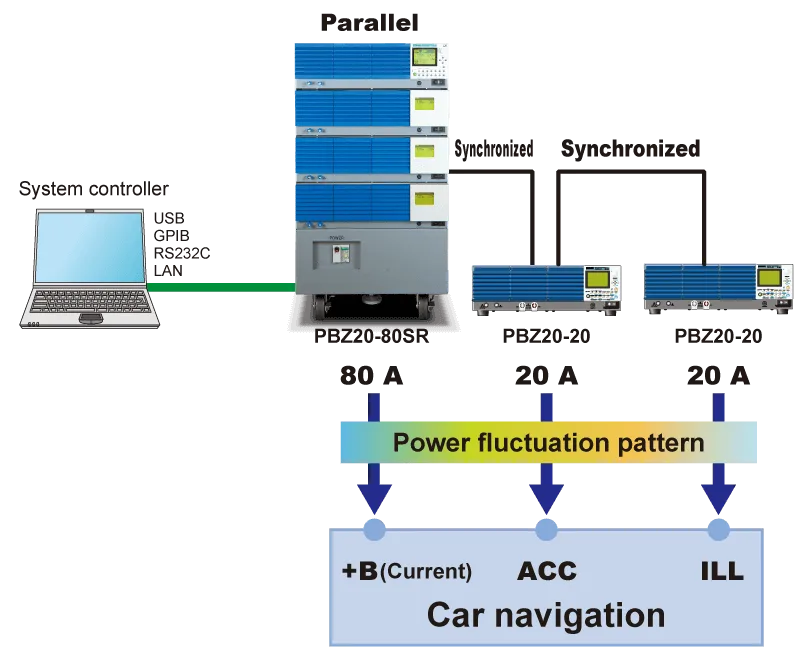
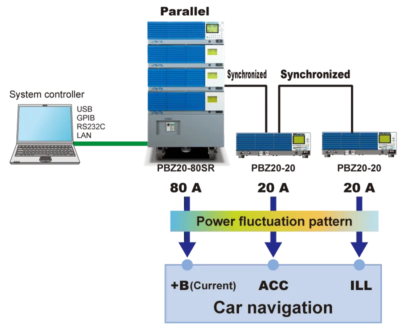
Trigger- and clock-based synchronization supports coordinated operation between instruments. Up to two same-model PBZ units can also be operated in parallel using the appropriate optional parallel-operation kit.
USB, GPIB, and RS232C interfaces support remote control and automated test systems. LAN connectivity is available as a factory option.
In addition to bipolar operation, the PBZ Series provides a unipolar operating mode for applications requiring single-polarity output behavior.
| Specification | PBZ20-20 | PBZ40-10 | PBZ60-6.7 | PBZ80-5 |
|---|---|---|---|---|
| Rated Output Voltage | ±20 V | ±40 V | ±60 V | ±80 V |
| Rated Output Current | ±20 A | ±10 A | ±6.7 A | ±5 A |
| Rated Output Power | 400 W | 400 W | 402 W | 400 W |
| Operating Method | Four-quadrant source / sink | Four-quadrant source / sink | Four-quadrant source / sink | Four-quadrant source / sink |
| CV Frequency Response | DC to 100 kHz (TYP) | DC to 100 kHz (TYP) | DC to 100 kHz (TYP) | DC to 100 kHz (TYP) |
| AC / Waveform Frequency Setting | 0.01 Hz to 100.00 kHz | 0.01 Hz to 100.00 kHz | 0.01 Hz to 100.00 kHz | 0.01 Hz to 100.00 kHz |
| Waveforms | Sine, square, triangle + 16 user-defined | Sine, square, triangle + 16 user-defined | Sine, square, triangle + 16 user-defined | Sine, square, triangle + 16 user-defined |
| Sequence Programs | 16 programs / 1024 total steps | 16 programs / 1024 total steps | 16 programs / 1024 total steps | 16 programs / 1024 total steps |
| Sequence Step Time | 100 µs to 1000 h | 100 µs to 1000 h | 100 µs to 1000 h | 100 µs to 1000 h |
| Measurement | Voltage / Current: DC, AC, DC+AC, Peak | Voltage / Current: DC, AC, DC+AC, Peak | Voltage / Current: DC, AC, DC+AC, Peak | Voltage / Current: DC, AC, DC+AC, Peak |
| Parallel Operation | Up to 2 same-model units* | Up to 2 same-model units* | Up to 2 same-model units* | Up to 2 same-model units* |
| Standard Interfaces | USB / GPIB / RS232C | USB / GPIB / RS232C | USB / GPIB / RS232C | USB / GPIB / RS232C |
| LAN | Factory option | Factory option | Factory option | Factory option |
| Nominal AC Input | 100 to 240 Vac, 50/60 Hz | 100 to 240 Vac, 50/60 Hz | 100 to 240 Vac, 50/60 Hz | 100 to 240 Vac, 50/60 Hz |
* Parallel operation requires the applicable optional parallel-operation kit. Rated output power shown above is the product's rated output specification. Sink-power limits depend on operating conditions and model; consult the official KIKUSUI specifications for detailed four-quadrant operating limits.
Unlike a conventional unipolar DC power supply, the PBZ Series can control both positive and negative voltage and current while transitioning continuously through zero.
This four-quadrant capability allows the instrument to operate as both a source and a sink. It is particularly useful when a device under test can return energy to the power supply or when test conditions require repeated reversal of voltage or current.