

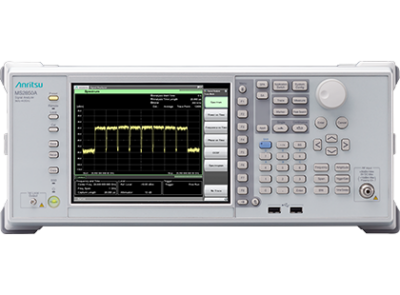

1 GHz Wideband Signal Analysis for 5G, Satellite and Broadband Systems
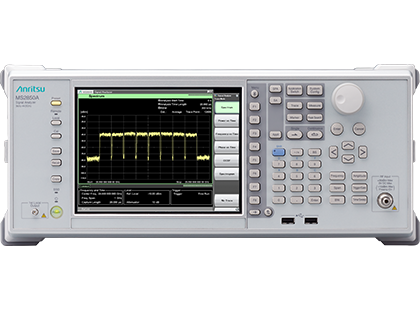
The Anritsu MS2850A is a high-performance spectrum analyzer and signal analyzer developed for wideband microwave and millimeter-wave signals used in 5G, satellite, and next-generation multicarrier communication systems.
Two frequency configurations provide native coverage from 9 kHz to either 32 GHz or 44.5 GHz. The signal analyzer includes 255 MHz analysis bandwidth as standard, with optional 510 MHz and 1 GHz bandwidths for capturing and analyzing wide instantaneous signal bandwidths.
Up to 1 GHz Analysis Bandwidth
Capture and analyze broadband and multicarrier microwave and mmWave signals with the applicable bandwidth option.
Up to 44.5 GHz Native Coverage
Choose 32 GHz or 44.5 GHz frequency configurations for sub-6 GHz and microwave/mmWave applications.
5G NR Signal Analysis
Optional measurement software supports sub-6 GHz and mmWave 5G NR transmitter and multicarrier analysis.
Wide Dynamic Range
High ADC clipping level, low noise floor and strong SFDR support accurate EVM and wideband signal measurements.
FFT-based signal analysis supports spectrum, spectrogram, power, frequency and phase versus time displays as well as Capture & Replay for investigating transient or time-varying signals. The platform is particularly suited to R&D and manufacturing applications where wide instantaneous bandwidth and accurate multicarrier measurement are required.
Maximum 1 GHz Analysis Bandwidth
The MS2850A provides 255 MHz analysis bandwidth as standard and can be configured with optional 510 MHz or 1 GHz bandwidth for broadband microwave and millimeter-wave signal analysis.
32 GHz or 44.5 GHz Frequency Coverage
Two main-unit configurations cover frequencies from 9 kHz to either 32 GHz or 44.5 GHz for applications ranging from conventional RF through microwave and mmWave bands.
5G NR Sub-6 GHz and mmWave Analysis
Applicable 5G measurement software supports transmitter and modulation analysis for sub-6 GHz and mmWave 5G NR signals, including FDD and TDD configurations according to the installed software.
Multicarrier Analysis
The wide analysis bandwidth supports simultaneous evaluation of multiple component carriers, helping reduce measurement time while allowing amplitude, phase, timing, EVM and frequency characteristics to be compared across carriers.
High Wideband Dynamic Range
A high ADC clipping level, low displayed average noise level and strong SFDR provide the measurement headroom required for accurate wideband modulation and EVM analysis.
Excellent Wideband Flatness
Optimized amplitude and phase flatness across wide analysis spans supports accurate characterization of broadband and multicarrier signals, including phased-array and 5G transmitter applications.
FFT Signal Analysis
Analyze captured signals using Spectrum, Power vs. Time, Frequency vs. Time, Phase vs. Time, CCDF/APD and Spectrogram displays for detailed time- and frequency-domain troubleshooting.
Capture & Replay
Store waveform data in internal memory and replay the captured signal using different display modes to investigate transient events and intermittent signal behavior.
High-Speed Data Transfer Options
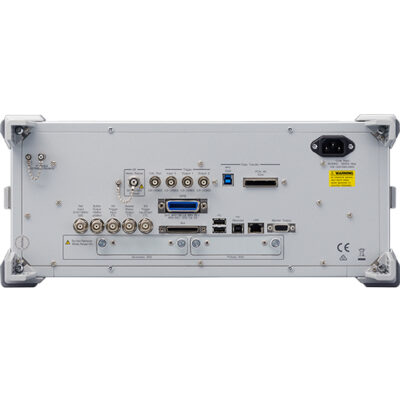
Optional PCIe and USB 3.0 interfaces support faster transfer of large captured data sets to external PCs for offline processing and development workflows.
External Millimeter-Wave Frequency Extension
With the applicable MX284090A software and recommended external mixers, the MS2850A can support extended spectrum and phase-noise measurements in V-band and E-band applications.
5G NR base-station transmitter development
Sub-6 GHz 5G signal analysis
28 GHz and 39 GHz mmWave signal analysis
Wideband EVM and modulation analysis
Multicarrier and carrier-aggregation evaluation
Satellite communications equipment development
Broadcast satellite signal evaluation
Broadband microwave communications testing
Wideband transmitter development and production test
Transient and time-varying signal analysis
Captured IQ signal analysis and offline processing
V-band and E-band spectrum measurement with supported external mixers
MS2850A Specifications
| Instrument Type | Spectrum Analyzer / Signal Analyzer |
|---|---|
| Frequency Range | 9 kHz to 32 GHz (MS2850A-047) or 9 kHz to 44.5 GHz (MS2850A-046) |
| Standard Analysis Bandwidth | 255 MHz |
| Optional Analysis Bandwidth | 510 MHz or 1 GHz |
| 255 MHz Analysis Range | 100 MHz to 32 GHz / 44.5 GHz |
| 510 MHz Analysis Range | 100 MHz to 32 GHz / 44.5 GHz |
| 1 GHz Analysis Range | 4.2 GHz to 32 GHz / 44.5 GHz with MS2850A-034 |
| SFDR | –60 dBc nominal from 800 MHz to below 4.2 GHz; –70 dBc nominal from 4.2 GHz to 44.5 GHz |
| Wideband Flatness Example | At 28 GHz center frequency and ±500 MHz: in-band frequency characteristics ±1.2 dB nominal; in-band phase linearity 5° p-p nominal |
| Dynamic Range Reference | Better than 140 dB reference performance at 28 GHz; Anritsu example shows 142 dB difference between ADC clipping level and DANL |
| Signal Analyzer Displays | Spectrum, Power vs. Time, Frequency vs. Time, Phase vs. Time, CCDF/APD and Spectrogram |
| Signal Capture | Capture & Replay using internal waveform memory |
| 5G Analysis | 5G NR sub-6 GHz and mmWave measurement functions with applicable software options |
| Other Measurement Applications | LTE-Advanced, vector modulation analysis, phase noise and noise figure functions available depending on installed software/options |
| High-Speed Data Transfer | Optional PCIe and USB 3.0 interfaces |
| External Frequency Extension | Supported with MX284090A and Anritsu-recommended external mixers for applicable V-band/E-band spectrum and phase-noise measurements |
Understanding the 1 GHz Analysis Bandwidth
The MS2850A provides up to 1 GHz instantaneous analysis bandwidth, but the usable frequency range depends on the selected analysis bandwidth.
The instrument itself provides native RF coverage from 9 kHz to either 32 GHz or 44.5 GHz. In Signal Analyzer mode, the standard 255 MHz analysis bandwidth and optional 510 MHz bandwidth are available from 100 MHz to the upper frequency limit of the installed model.
255 MHz
Standard analysis bandwidth from 100 MHz to 32 GHz or 44.5 GHz.
510 MHz
Optional analysis bandwidth from 100 MHz to 32 GHz or 44.5 GHz.
1 GHz
Optional analysis bandwidth available from 4.2 GHz to 32 GHz or 44.5 GHz.
For measurements above the instrument's native frequency range, the MX284090A External Mixer Connection Function can be combined with supported external mixers for selected millimeter-wave spectrum and phase-noise applications. This external-mixer solution should not be interpreted as providing native 1 GHz vector signal analysis through 90 GHz.