


RP2040-Based Control Expansion for MIPI and SerDes Evaluation
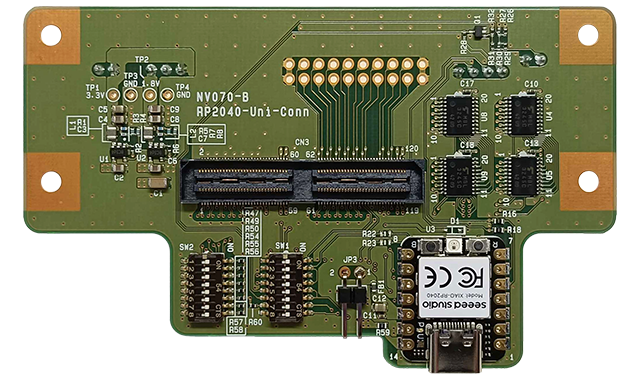
The NetVision NV070-B MIPI-Uni-Conn is an RP2040-based expansion board for adding customizable I2C, GPIO, and standalone control functions to NetVision MIPI and automotive SerDes evaluation systems.
Equipped with a XIAO RP2040 module, the NV070-B can be combined with NetVision SV-series main boards and SerDes interface boards to implement application-specific control sequences without relying entirely on a PC.
XIAO RP2040
Programmable microcontroller for custom evaluation control
I2C Master / Slave
Control devices or emulate sensor-side I2C responses
1.8 V to 3.3 V
Supported target-side I/O voltage range
Standalone Control
Run initialization and control sequences with fewer external devices
The RP2040 can operate as an I2C master to initialize cameras, serializers, deserializers, and peripheral devices, or as an I2C slave to emulate sensor responses expected by a camera ECU during startup.
GPIO connectivity and an I/O expander provide additional control for reset signals, status lines, interrupts, and other evaluation-specific signals. The board can also operate without an SV board, making it useful for EMC testing and other setups where PC and evaluation-board connections need to be minimized.
XIAO RP2040 Control Platform
The onboard XIAO RP2040 provides a programmable control environment for implementing evaluation-specific firmware using MicroPython or the Raspberry Pi Pico SDK.
I2C Master Control
Control cameras, serializers, deserializers, and peripheral ICs directly from the RP2040 for device initialization and automated test sequences.
I2C Slave Response Emulation
Configure the RP2040 as an I2C slave to emulate sensor responses expected by camera ECUs during startup and sensor-detection sequences.
GPIO Control and I/O Expansion
Control reset, enable, interrupt, status, and other digital signals through direct GPIO connectivity and the onboard I/O expansion architecture.
Standalone Operation
Run initialization and control firmware without an SV board, reducing external equipment requirements for EMC and other constrained test environments.
Flexible SerDes Integration
Connect the board to compatible NetVision serializer or deserializer boards to customize camera and automotive SerDes evaluation workflows.
Firmware Samples
NetVision provides a MicroPython I2C Master sample and a Pico SDK-based I2C Slave sample as starting points for customer-specific implementations.
Camera Power Detection
An onboard circuit and connector can detect camera power in the 5 V to 16 V range for evaluation-system integration.
Camera ECU startup verification
Sensor I2C response emulation
Automotive SerDes evaluation
Camera and SerDes device initialization
EMC test control
Standalone camera evaluation
GPIO and reset-sequence control
Initial evaluation without a physical sensor
| Model | NV070-B |
|---|---|
| Product Name | MIPI-Uni-Conn |
| Microcontroller | XIAO RP2040 |
| Main Functions | I2C control, I2C slave response, GPIO control, standalone operation |
| Supported I/O Voltage | DC +1.8 V to +3.3 V |
| SV Board Connection | CN4 |
| Target / SerDes Connection | CN3 |
| USB Connection | XIAO RP2040 USB Type-C |
| Camera Power Detection | 5 V to 16 V via CN5 detection circuit |
| Firmware Development | MicroPython / Pico SDK |
| Board Dimensions | 101.6 × 62.0 mm |