

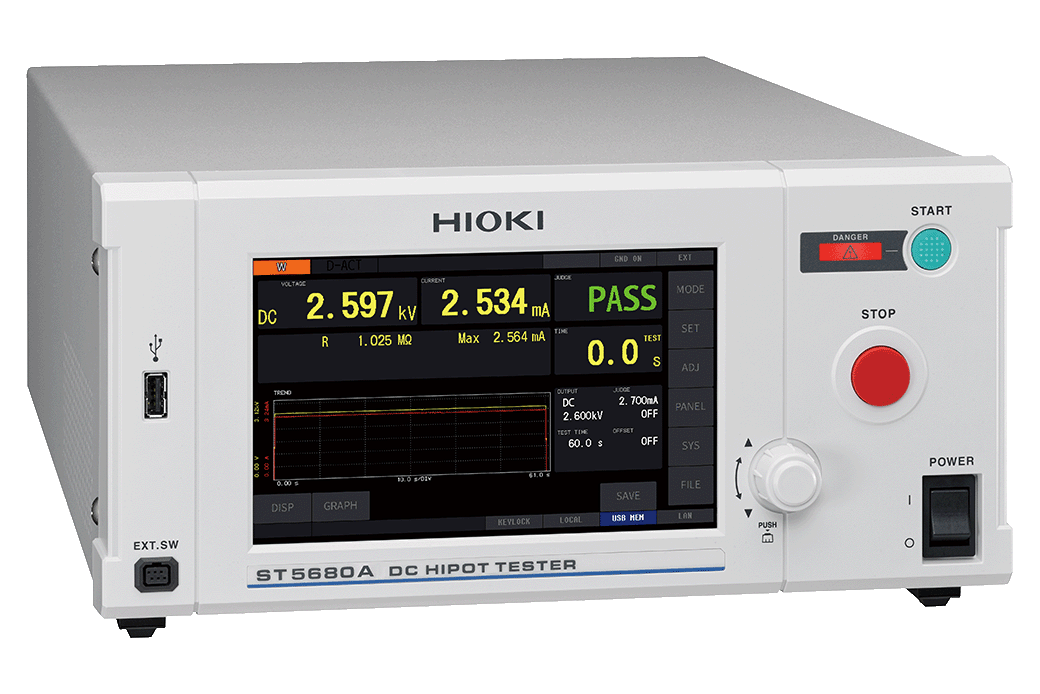
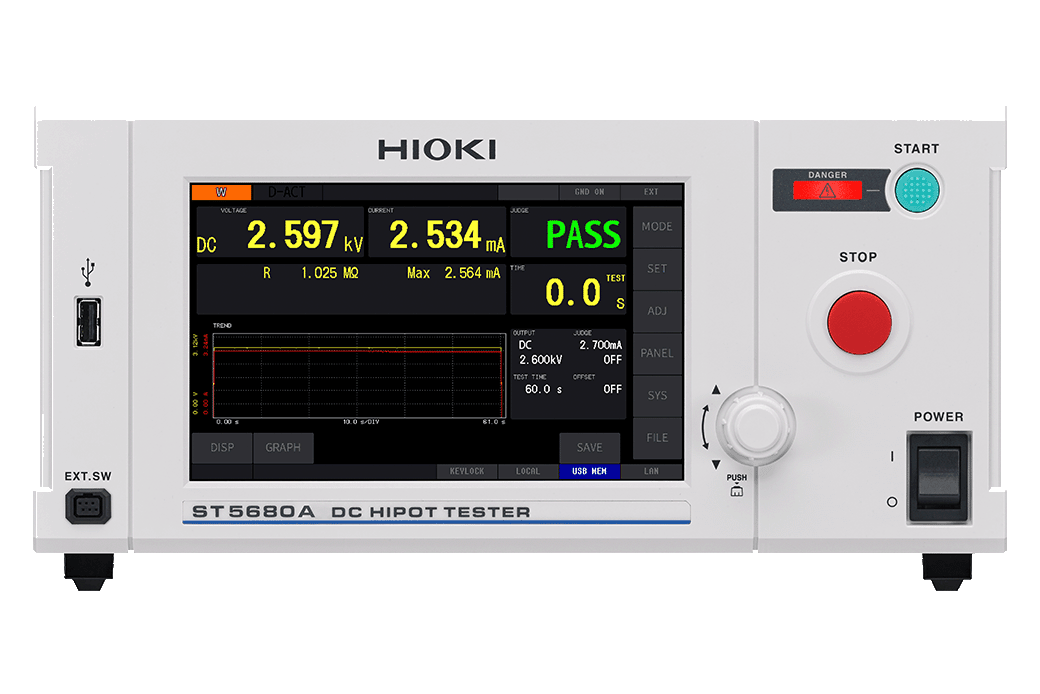

ST5680A DC Hipot Testing with Integrated Waveform Analysis
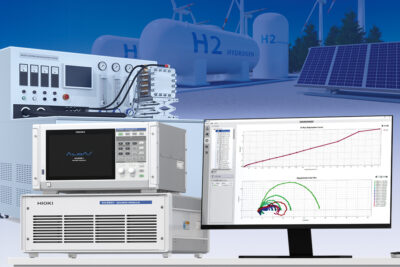
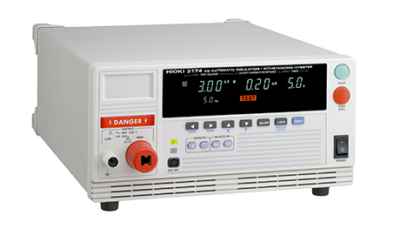
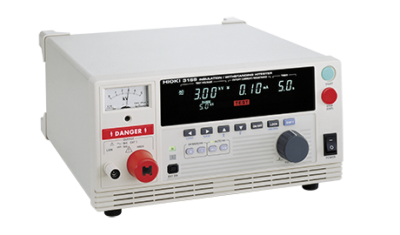
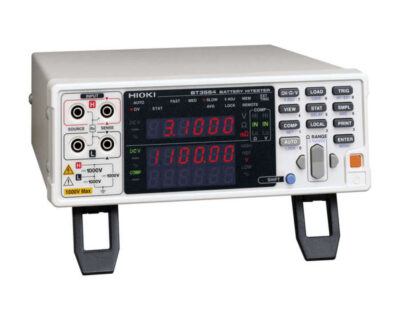
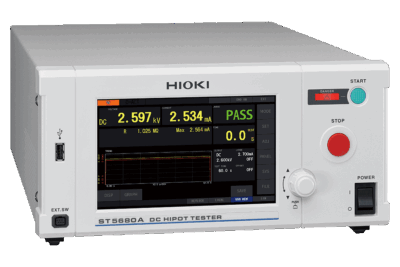
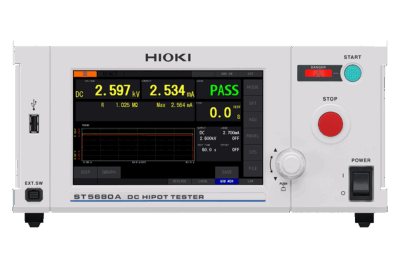
The HIOKI ST5680A is a DC electrical safety tester designed to examine insulation withstand performance and diagnose abnormal behavior in EV battery production and development.
The tester combines DC hipot, insulation resistance, and breakdown voltage (BDV) measurement in a single platform. It displays time-series voltage, current, and insulation resistance waveforms during testing, helping engineers investigate events that cannot be understood from a simple PASS/FAIL result.
A capacitance-based contact check monitors the connection between the test fixture and the device under test. Arc detection monitors changes in test voltage that may indicate transient insulation problems.
8 kV / 20 mAMaximum DC hipot output voltage / cutoff current
0.001 µAMinimum current measurement resolution
500 kS/sMaximum waveform sampling rate
128 sMaximum selected waveform display/recording span
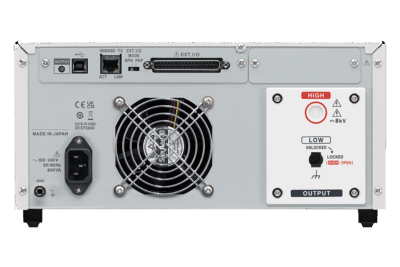
Interlock, automatic discharge, voltage limit, test-program storage, and USB/LAN connectivity support repeatable test procedures and automated production-line operation.
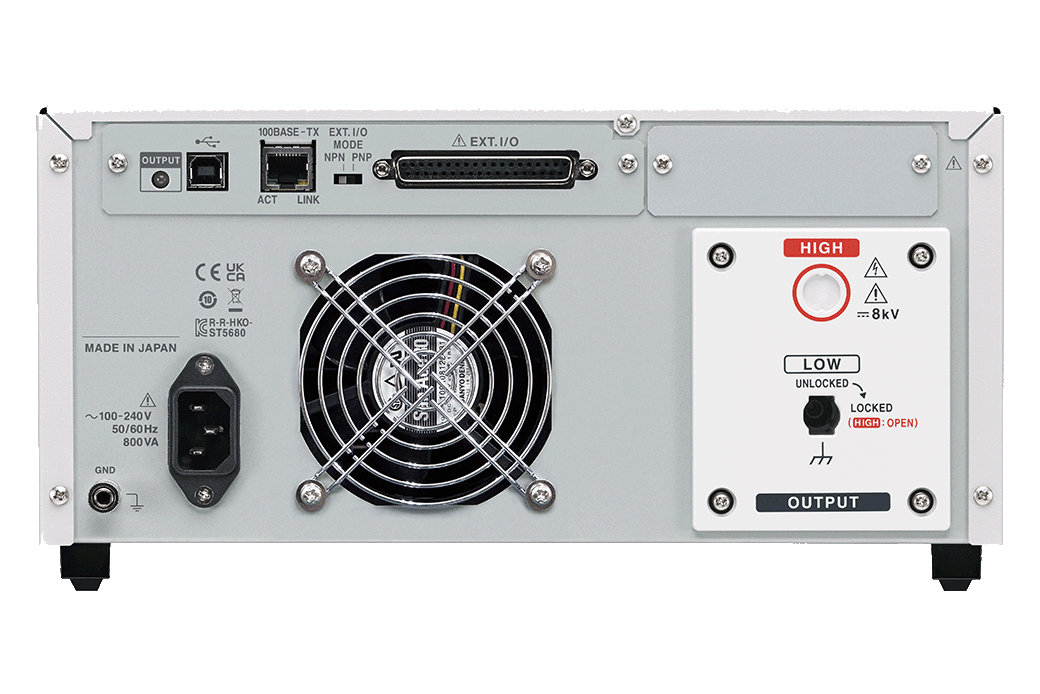
The tester requires a compatible dedicated HIOKI high-voltage lead; it is not designed for generic BNC, coaxial, or banana test cables.
DC Hipot and Insulation Resistance Testing
Performs DC withstand voltage testing from 0.010 to 8.000 kV and separate insulation resistance testing with 10 to 2000 V DC test output.
Waveform Intelligence
Displays and records voltage, current, and insulation resistance as time-series waveforms with sampling up to 500 kS/s and display spans up to 128 s.
Integrated Contact Check
Capacitance-based contact verification helps identify inadequate fixture, test-lead, or relay connections that could lead to false PASS judgments.
Arc and Breakdown Analysis
Arc detection and continuous/stepped-rise BDV test methods help examine insulation breakdown behavior and abnormal voltage changes.
High-Voltage Test Safeguards
Voltage limitation, external interlock, and automatic discharge help manage safety in properly engineered high-voltage test fixtures.
Production-System Connectivity
Standard USB, LAN, and EXT. I/O, with optional RS-232C and GP-IB, support data transfer and automated test system integration.
EV Battery Cell Inspection
Assess DC withstand performance between cell electrodes and enclosures during development or production inspection.
Battery Module Qualification
Verify insulation withstand behavior on assembled modules using controlled voltage and test timing.
EV Battery Pack Safety Testing
Apply DC hipot and insulation-resistance checks to pack assemblies with suitable high-voltage fixtures.
Breakdown Voltage Characterization
Use BDV rise-test methods to characterize dielectric breakdown of components or insulating materials.
Production-Line Fault Analysis
Inspect recorded leakage-current and voltage waveforms to investigate abnormal or marginal test events.
Automated Electrical Safety Inspection
Integrate test sequences, PASS/FAIL output, interlocks, and communications into production inspection stations.
ST5680A Basic Specifications
| DC hipot output voltage | 0.010 to 8.000 kV DC; 1 V setting resolution |
|---|---|
| DC hipot maximum output/cutoff current | 20 mA (at test voltages of 50 V or higher) |
| Current minimum resolution | 0.001 µA |
| Insulation resistance test output | 10 to 2000 V DC; 1 V resolution |
| Insulation resistance display range | 100.0 kΩ to 200.0 GΩ; accuracy-guaranteed range is narrower |
| BDV test methods | Continuous voltage rise; stepped voltage rise |
| Waveform channels | Voltage, current, insulation resistance |
| Waveform sampling | Up to 500 kS/s; display span 0.5 to 128 s |
| Contact check | Capacitance method; 1.0 to 100.0 nF threshold setting |
| Communication | USB, LAN, EXT. I/O standard; optional RS-232C, GP-IB |
| Line power | 100 to 240 V AC, 50/60 Hz |
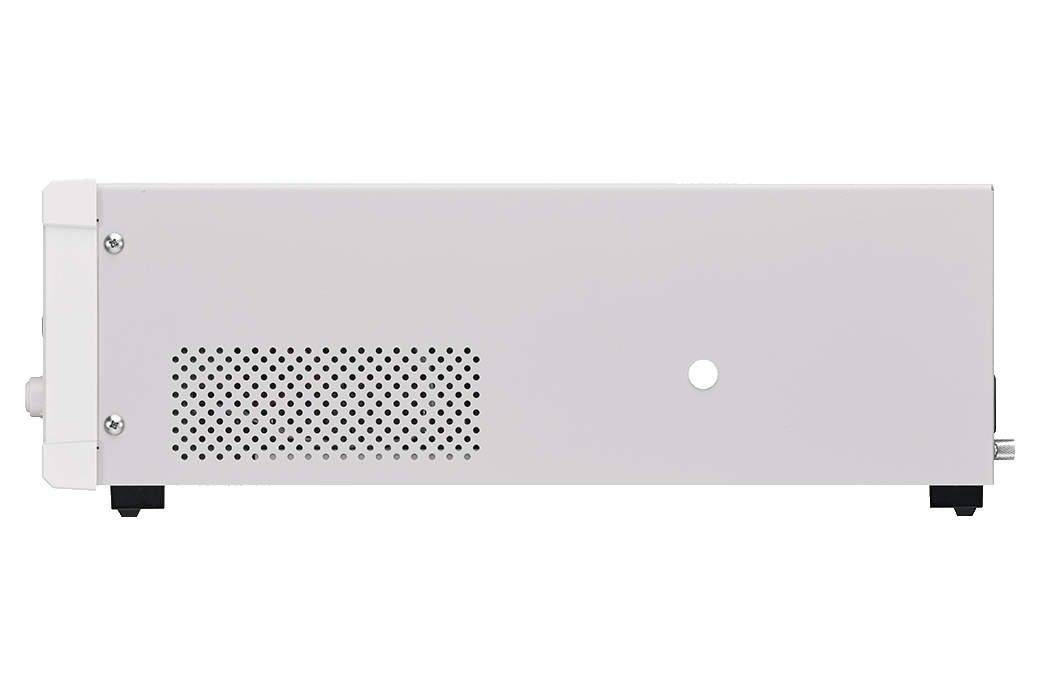
| Size and mass | Approx. 305 × 142 × 430 mm (W × H × D); 10.4 kg |
| Operating conditions | 0 to 40°C, ≤80% RH, non-condensing |
High-voltage leads L2260 or L2261 must be ordered separately; the tester cannot operate with generic leads. Exact conditions and accuracy depend on test mode.