


HIOKI Powder Impedance Measurement System
Evaluate the mechanical and electrical properties of battery powders while applying compression inside a glove box.
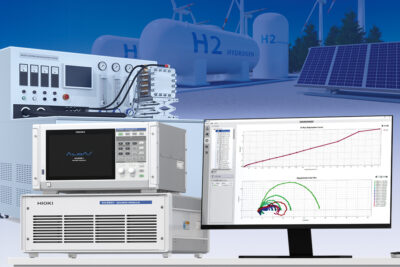
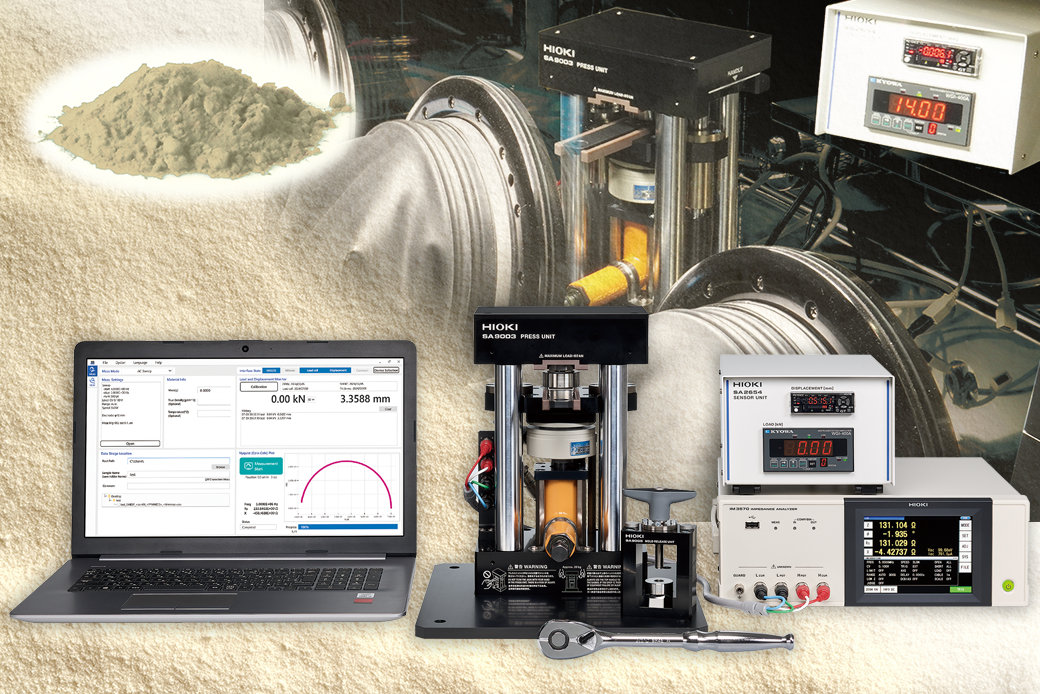
HIOKI’s Powder Impedance Measurement System combines a press, powder test fixture, force/thickness monitoring and software with a separately selected electrical measurement instrument. Its compact design enables powder loading, compression and electrical characterization within a controlled glove-box environment.
The SA9003 press can apply up to 60 kN, corresponding to 764 MPa with the φ10 mm SA9004-01 electrode geometry. The system measures impedance, pressure and thickness simultaneously and supports derived analyses such as bulk density, ionic conductivity and related electrical properties.
The press is manually operated and cannot automatically maintain a constant force. Measurement frequency depends on the separately purchased instrument and leads: IM3533, IM3570 and RM3545A serve different AC impedance or DC resistance use cases. The overall claimed DC-to-5-MHz capability covers configurations, not a single instrument.
60 kN
Maximum applied load
764 MPa
At φ10 mm electrode
±10 μm
Specified thickness error*
Glove-box ready
Compact press and test fixture
Simultaneous Mechanical and Electrical Data
Measure compression force, material thickness and impedance within the same powder testing workflow.
Compact Glove-Box Operation
Keep sensitive sulfide or halide-based powders in a low-moisture enclosure during sample preparation and measurement.
Repeat Tests with One Sample
Vary applied manual load and acquire repeated readings without requiring a new sample for every pressure condition.
Nyquist-Based Analysis
Software supports impedance plots and resistance estimation from arc fitting when using an AC impedance configuration.
Configurable Electrical Measurement
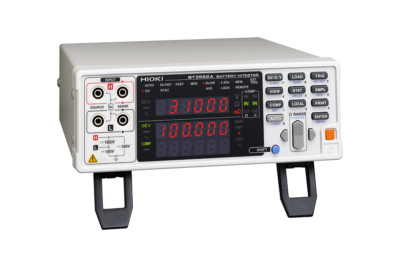
Select compatible IM3533 / IM3570 impedance instruments or RM3545A resistance meter depending on the material and parameter.
Integrated Measurement Workflow
SA2653 software and SA2654 sensor unit support pressure/displacement acquisition and correlated data review.
Solid Electrolyte Screening
Study powder ionic conductivity as compression pressure changes during battery materials research.
All-Solid-State Battery R&D
Evaluate material behavior under controlled low-moisture conditions in glove boxes.
Dry Electrode Material Evaluation
Characterize conductive additives and dry-process powder compositions.
Composite Cathode Formulation
Compare material blend ratios using electrical and mechanical response during compression.
Pressure–Conductivity Studies
Map relationships among pressure, thickness, bulk density and measured impedance.
Material Handling Risk Reduction
Minimize repeated removal of air-sensitive materials from dry testing environments.
HIOKI Powder Impedance Measurement System Specifications
| System type | Multi-unit powder compression and impedance/resistance measurement system |
|---|---|
| Press model | SA9003 Press Unit |
| Maximum compression load | 60 kN |
| Maximum applied pressure | 764 MPa with SA9004-01, φ10 mm electrode |
| Load application | Manual; constant-load automatic control not available |
| Load measurement accuracy | ±3% of full scale |
| Thickness measurement error | ±10 μm after calibration in constant temperature; 10–60 kN increasing-load conditions |
| Test fixture | SA9004-01; φ10 mm electrode |
| Powder filling section | φ10 mm, 7 mm depth |
| Electrical measurement frequency | Overall supported configurations: DC to 5 MHz; dependent on chosen instrument |
| Compatible AC instruments | IM3533 LCR Meter; IM3570 Impedance Analyzer |
| Compatible DC instrument | RM3545A Resistance Meter |
| Software | SA2653 Measurement Software |
| Sensor unit | SA2654 Sensor Unit |
| Mold release option | SA9005 Mold Release Unit |
| Operating environment | 23°C ±5°C, 80% RH or less (non-condensing); protect powders as required |
| Component weight | SA9003 approx. 20.7 kg; SA2654 approx. 2.3 kg |
| Ordering / integration note | Electrical measuring instrument and dedicated connection cable ordered separately |
The 764 MPa figure is geometry dependent (φ10 mm electrode); it is not a generic press limit independent of fixture diameter. The press is manual, and an electrical analyzer or meter plus cable must be purchased for a working system. The ±10 μm thickness condition requires calibration and increasing load from 10 to 60 kN.