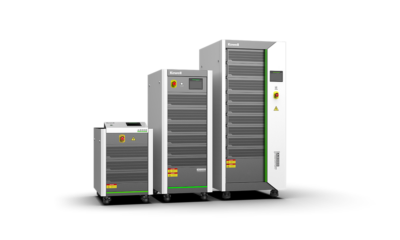


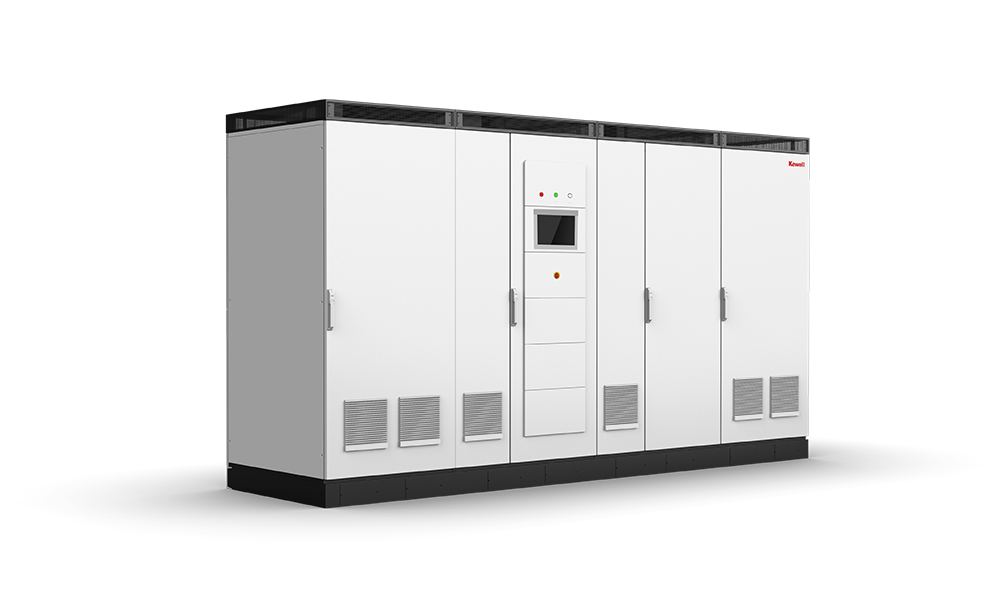

Kewell A1100 Series E-Motor Emulator
Model-driven motor and load simulation for traction inverters, motor controllers and EV powertrain validation without a spinning motor.
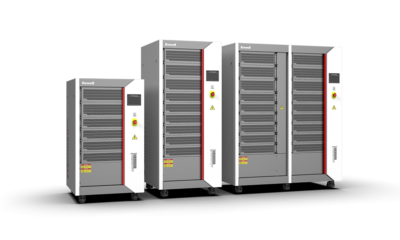
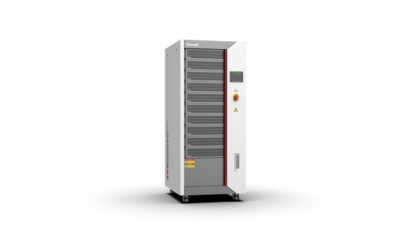
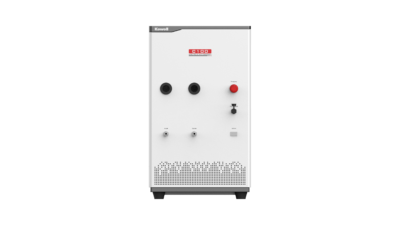
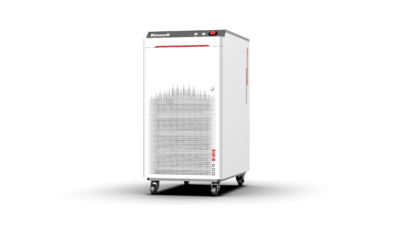
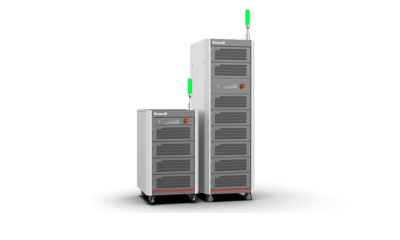
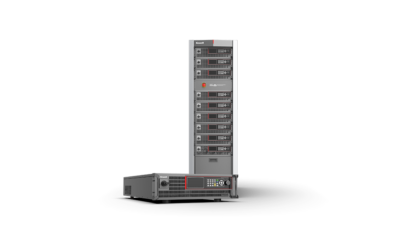
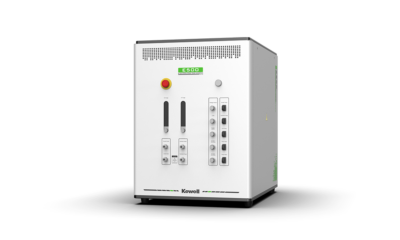
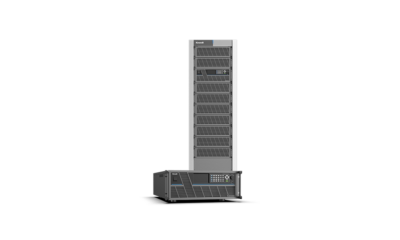
The Kewell A1100 Series is an electronic motor emulator designed to present a motor-like electrical load to an inverter or motor controller. Instead of mechanically coupling a motor to a dynamometer, the system uses fast power-electronic switching and dynamic calculations to reproduce the electrical behavior of permanent-magnet synchronous motors (PMSMs) and asynchronous/induction motors.
Kewell describes its product family in the 100–800 V and 30–600 kW classes. These numbers designate a family envelope rather than a single instrument operating across all voltages and powers at once. Motor parameters, permissible operating points, current capability, cooling and installation requirements must be selected for the ordered model.
Bidirectional energy transfer, motor/load model parameterization, injected electrical faults and rapid dynamics support development of control software, drive-inverter protection logic and reproducible fault scenarios. The manufacturer lists a control response time of 1 ms or less, but the practical system response depends on the selected emulator and test condition.
An A1100 does not itself measure mechanical torque or replicate every physical phenomenon of an actual rotating motor. It is best considered an electrical emulator for bench, integration and controller test programs, and should be specified together with the inverter under test, DC supply, power handling and facility protection architecture.
30–600 kWKewell series power class
100–800 VPublished product-family class
≤1 msVendor-listed response time
PMSM + ASMMotor-model families supported
Explore EV power electronics testing
Electrical Emulation without a Motor
Present electronically synthesized motor terminal behavior to a controller or drive inverter.
PMSM and Induction Motor Models
Configure parameter-based representations of synchronous and asynchronous motor characteristics.
Bidirectional Energy Transfer
Support four-quadrant-style operating scenarios with suitable system power and regeneration architecture.
Fault Injection for Controller Validation
Reproduce supported electrical fault conditions to examine inverter and controller responses.
Fast Model Dynamics
Manufacturer cites response of 1 ms or less for high-dynamic bench test scenarios.
Repeatable Automated Testing
Use the vendor-listed communications and data export features for validation and controller-development workflows.
EV Traction Inverter Development
Evaluate inverter drive commands and responses without installing a rotating traction motor.
PMSM Controller Algorithm Validation
Compare electrical operation under different motor-parameter settings and commanded drive points.
Asynchronous Motor Drive Testing
Apply modeled induction-motor behavior to industrial frequency converters.
Drive Fault and Protection Testing
Introduce supported fault cases to study diagnostic responses and protection strategies.
Powertrain Software Integration
Use repeatable motor characteristics when integrating controller firmware with power hardware.
End-of-Line Controller Validation
Implement selected electrical motor emulation procedures for production or qualification checks.
Kewell A1100 Series E-Motor Emulator Specifications
The manufacturer public product page supplies series-level voltage/power ranges and functions but does not publish a complete numeric per-model matrix in page text. Values below are not a universal single-SKU rating.
Published Product Family Characteristics
| Specification | A1100 Series |
|---|---|
| Equipment category | Power-electronic motor and load emulator |
| Test object | Motor control units, traction inverters, general frequency converters |
| Published voltage class | 100–800 V (series filter/range) |
| Published power class | 30–600 kW (series filter/range) |
| Motor model types | Permanent-magnet synchronous motor (PMSM); asynchronous/induction motor (ASM) |
| Model basis | Dynamic electrical motor and load mathematical models |
| Energy-flow operation | Bidirectional |
| Control response | ≤1 ms (manufacturer published claim) |
| Fault simulation | Available as a system test function; supported faults depend on configuration |
| Data capture | High-speed data storage and export functions listed by Kewell |
| Control/communication | Standard communication interfaces; verify protocol/port for quoted system |
| Synchronous generator scenario | Manufacturer describes AC source behavior under generator mode |
| DUT protection | Manufacturer-listed protection functions; specific limits depend on system |
| Voltage/current/power combination | Depends on ordered SKU and operating region; do not assume maxima occur simultaneously |
| Installation requirements | Verify line power, regeneration, cooling, emergency-stop and facility protection |
Test Planning and Configuration Checklist
| Design Parameter | Engineering Check |
|---|---|
| Inverter voltage and DC link | Match DC-link operating points, modulation method and relevant terminal envelope |
| Peak / continuous apparent power | Define steady and transient phase-current demands and available regeneration |
| Motor model parameters | Confirm PMSM/induction-motor electrical parameters and supported model ranges |
| Fault library and safe shutdown | Confirm fault types, trigger/response methods and protective interlocks |
| Interface integration | Specify required drive commands, communication protocol and logging |
| Acceptance testing | Agree on response, model fidelity and test procedure with Kewell before ordering |