Home » Electronic Measuring Instruments » Electronic Loads » Electronic Load » TEXIO LSG-A Series Programmable DC Electronic Loads
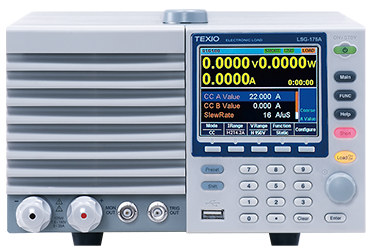
TEXIO LSG-A Series Programmable DC Electronic Loads
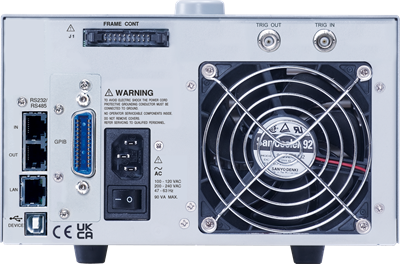
LSG-A Series Programmable DC Electronic Loading

The TEXIO LSG-A Series provides programmable, non-regenerative DC electronic loads for controlled source testing, from compact benchtop work to multi-unit higher-power systems.

Two model families cover different DUT voltages: the 150 V class (LSG-175A, LSG-350A and LSG-1050A) operates over 1.5–150 V DC, while the 800 V class (LSG-175AH, LSG-350AH and LSG-1050AH) operates over 5–800 V DC.

Each voltage family offers 175 W, 350 W and 1050 W self-contained load instruments. Separate LSG-2100AS (150 V) and LSG-2100ASH (800 V) 2100 W boosters are expansion modules, not standalone electronic-load mainframes.

150 V / 800 VTwo DC operating-voltage families
175–1050 WThree main-instrument power ratings
Up to 9.45 kW1050 W master + four 2100 W boosters
7 ModesCC, CV, CR, CP and combined modes

The programmable load supports CC, CV, CR, CP, CC+CV, CR+CV and CP+CV operation, plus sequence and program functions for repeatable load profiles. Standard USB, LAN, RS-232C and analog control/monitoring aid bench and system integration.

Rated power, voltage and current limits apply together at the chosen operating point. These are dissipative electronic loads; power is absorbed and dissipated as heat rather than regenerated to the electrical grid.

150 V and 800 V Families

Select 1.5–150 V (A) or 5–800 V (AH) depending on DUT operating voltage and safety requirements.

175 W, 350 W and 1050 W Mainframes

Three standalone load capacities are available in each voltage family, for six primary instrument choices.

Seven Load Operating Modes

CC, CV, CR, CP, CC+CV, CR+CV and CP+CV provide flexible electronic-load behavior for suitable devices under test.

Up to 9.45 kW Expansion

Pair a compatible 1050 W master with up to four matching 2100 W boosters to reach a 9450 W system rating.

Programs and Sequences

Create programmed loading routines and repeatable sequences for source response and production test procedures.

Standard Remote Control Interfaces

LAN, USB, RS-232C and analog control/monitoring support integration; optional GP-IB requires the manufacturer-specified interface.

DC Power Supply Verification

Apply controlled electrical loads while checking regulated DC supplies under current, voltage or power limits.

DC-DC Converter Evaluation

Characterize converters at defined load points and programmable load-change sequences.

Battery Discharge Evaluation

Sink current from appropriately protected DC batteries within safe voltage, current, power and test-time limits.

Transient Response Testing

Generate step or sequence loading to examine source regulation and control-loop response.

High-Voltage DC Load Testing

Use AH 800 V-class models for appropriate high-voltage sources with rated input and electrical safety procedures.

Automated Production Validation

Integrate load commands and measurement readback through standard remote-control connections.

LSG-A / LSG-AH Series Technical Specifications

Instrument familyProgrammable, dissipative DC electronic loads
Self-contained instrument models6 models: 175 W, 350 W and 1050 W in both voltage families
Booster models2 models: LSG-2100AS (150 V); LSG-2100ASH (800 V)
150 V family operating-voltage range1.5–150 V DC
800 V family operating-voltage range5–800 V DC
Power ratings for main instruments175 W; 350 W; 1050 W
Per-booster capacity2100 W (booster requires compatible master configuration)
Highest manufacturer-stated configuration9450 W total with one 1050 W master + four 2100 W matching boosters
Control / operating modesCC; CV; CR; CP; CC+CV; CR+CV; CP+CV
ProgrammabilitySequence function and repetitive program routines
Standard remote interfacesUSB; LAN; RS-232C; analog control and monitoring
Optional interfaceGP-IB using the appropriate option
Protections and limit settingsOPP, OCP and OVP settings (refer to model manual for scope)
Standalone vs. booster distinctionOnly 175 / 350 / 1050 W models are main instruments; 2100 W AS/ASH units are booster modules

LSG-A Eight-Configuration Comparison

ModelOperating DC voltageMax. currentRated powerRole
LSG-175A1.5–150 V35 A175 WMain instrument
LSG-350A1.5–150 V70 A350 WMain instrument
LSG-1050A1.5–150 V210 A1050 WMain instrument
LSG-175AH5–800 V8.75 A175 WMain instrument
LSG-350AH5–800 V17.5 A350 WMain instrument
LSG-1050AH5–800 V52.5 A1050 WMain instrument
LSG-2100AS1.5–150 V420 A2100 WBooster only
LSG-2100ASH5–800 V105 A2100 WBooster only

Do not multiply maximum current by maximum input voltage to infer usable power: each operating point must remain within the voltage/current/power envelope. The 2100 W AS and ASH units are booster modules and require a compatible LSG-1050A or LSG-1050AH master system, respectively. The 9.45 kW figure is a multi-unit configuration, not a rating of one instrument.

System Expansion, Controls and Application Boundaries

High-power expansion: A 1050 W master can be combined with up to four matching 2100 W boosters, giving a published 9450 W system capacity. The 150 V and 800 V boosters are different models; confirm manufacturer-approved pairing and wiring. Legacy-series compatibility: TEXIO distinguishes current LSG-A / LSG-AH from older LSG / LSG-H. Its manual warns that an A/AH booster cannot be connected with an old LSG/LSG-H master; verify installed-system revision before adding boosters. Communication details: The LSG-A family includes LAN and RS-232C connections, USB and analog control/monitoring. Do not market RS-485 as fully supported: the manual notes it is not supported in the stated version. Regeneration: These are DC electronic loads that dissipate power. Do not describe the LSG-A as a regenerative, grid-return or bidirectional DC supply. Solution navigation: Compare use cases at Denkei’s Electronic Load Testing Solution page and other suitable load models when selecting DC test equipment. Accessory scope: Confirm correct booster interconnect cables, input wiring, GP-IB option and heat/airflow requirements for the chosen rack or bench configuration.