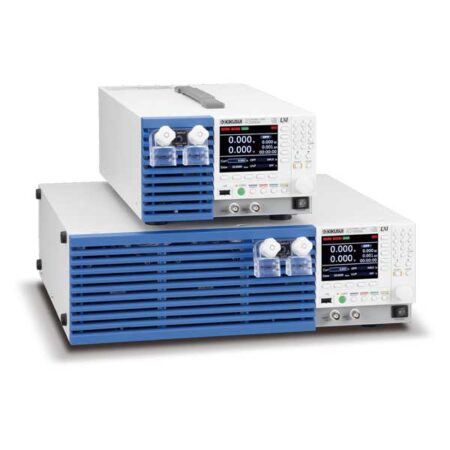
KIKUSUI PLZ-5W Series Multifunctional Electronic Load
Programmable DC electronic load for general power-supply, converter, battery, and automated loading applications.
View PLZ-5W SeriesDC Load · Dynamic · High Voltage · Regenerative · Multichannel
Select an electronic-load architecture based on DUT voltage, current, power, dynamic behavior, energy handling, and channel count.
Use the DUT output and test sequence to determine whether the setup needs a general programmable load, high-voltage capacity, regeneration, or multichannel loading.
FIND YOUR SOLUTION
Choose the loading workflow that best matches the DUT output and test sequence.
Programmable DC loading
Apply controlled static and programmed loading to power supplies, converters, batteries, and other DC sources.
Recommended for this solution
Programmable DC electronic load for general power-supply, converter, battery, and automated loading applications.
View PLZ-5W SeriesFast-changing load profiles
Evaluate DUT response to changing current or load conditions using programmed switching, sequences, and transient load profiles.
Recommended for this solution
Programmable DC electronic load for general power-supply, converter, battery, and automated loading applications.
View PLZ-5W SeriesHigher-voltage DC loading
Absorb controlled power from higher-voltage power supplies, converters, batteries, and power-electronics systems.
Recommended for this solution
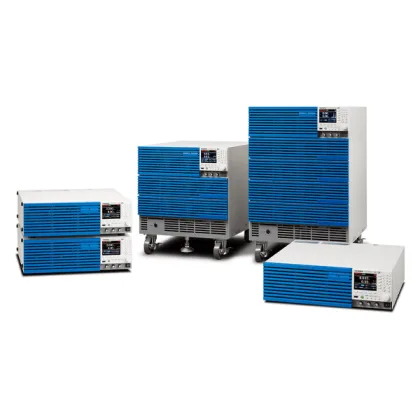
High-voltage, high-capacity DC load platform for power supplies, converters, batteries, and high-voltage power electronics.
View PLZ-5WH2 SeriesEnergy-regenerative loading
Apply controlled high-power loading while returning absorbed energy to the facility where the selected system and installation support regenerative operation.
Recommended for this solution
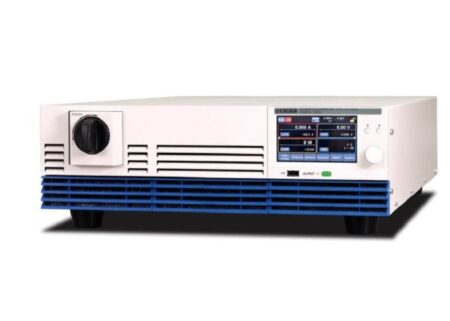
High-capacity regenerative DC electronic load for repeated power absorption where returning energy to the facility is useful.
View PXZ SeriesMulti-output and production loading
Use compact independent or synchronized load channels for multi-output supplies, components, battery cells, and automated production systems.
Recommended for this solution
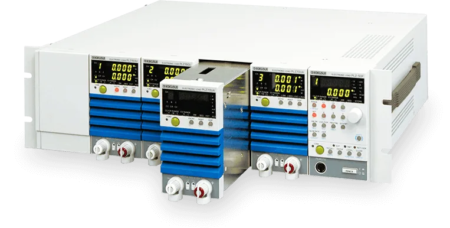
Compact modular multichannel load platform for independent or synchronized loading in component and production systems.
View PLZ-U SeriesElectronic Load Selection
Electronic loads should be selected from the actual input operating area, required load modes, transient behavior, power dissipation or regeneration, and system integration needs.
Electronic Load Test Architectures
A general DC electronic load, high-voltage load, regenerative load, and modular multichannel load serve different test environments. Select by the actual DUT output envelope and the required load profile.
Use a general programmable load for flexible DC source characterization, automated sequences, and common steady-state or dynamic loading.
Dynamic loading helps evaluate how a source responds when the connected load changes over time.
Select a high-voltage/high-power load when the DUT output envelope exceeds a general benchtop load or when a scalable system is required.
Regenerative loads are especially useful when repeated or long-duration tests would otherwise dissipate substantial energy as heat.
A modular multichannel architecture reduces bench space and simplifies coordinated loading when several outputs or DUTs must be tested.
Load Architecture Comparison
All electronic loads absorb power from the DUT, but their voltage/current operating areas, dynamic behavior, channel structure, and energy handling differ.
| Load architecture | Primary distinction | Typical use |
|---|---|---|
| General programmable DC load | Flexible operating modes and sequences | Power supplies, converters, batteries, and automated test |
| High-voltage / high-power load | Higher voltage and power operating area | High-voltage power electronics and larger DC systems |
| Regenerative load | Returns absorbed energy to the facility where supported | Repeated higher-power loading and long-duration test |
| Modular multichannel load | Multiple compact independent or synchronized channels | Multi-output supplies, components, and production systems |
Frequently Asked Questions
An electronic load absorbs controlled current or power from a device under test. It is commonly used to evaluate power supplies, converters, batteries, chargers, and other sources under defined loading conditions.
The correct mode depends on the DUT behavior and the test objective. Constant current is common for source characterization, constant resistance can emulate resistive behavior, constant voltage can clamp the DUT to a set voltage, and constant power is useful when the test requires approximately fixed absorbed power.
A regenerative load is useful when significant power must be absorbed for long or repeated tests. Instead of dissipating all absorbed power as heat, a compatible regenerative system can return energy to the facility, subject to installation requirements.
Use a high-voltage load when the DUT output exceeds the voltage operating area of a general load or when the application requires a higher-voltage and higher-power loading system. Always verify the full voltage/current/power operating envelope.
A modular platform is useful when several outputs or devices must be loaded independently or synchronously in a compact system, especially in production, component, or multi-output power-supply testing.
Application Support
Share the DUT output voltage, current, continuous and peak power, required load modes, transient profile, test duration, channel count, and automation needs. Denkei Americas can help narrow the appropriate KIKUSUI load architecture.