SPM (Scanning Probe Microscope) Signal Processing 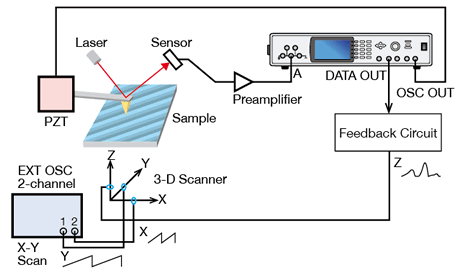 |
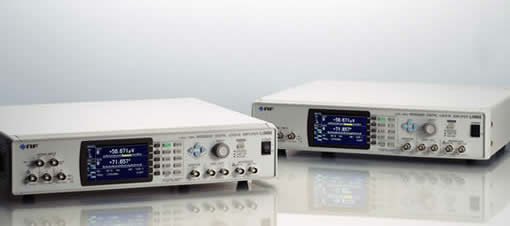
| Scanning probe microscopes such as STM (scanning tunnel microscope) and AFM (atomic force microscope) use a nanoscale probe at the tip to scan the surface of a sample. The signal between the probe and the sample is detected to observe the electronic state and structure of the sample surface, as well as its physical and chemical properties. Lock-in amplifiers are used to control the distance between the sample and probe. The LI5600 series can also be used with high resonance frequency cantilever movement in the MHz range, and setting a smaller time constant (from 1 μs) allows high-speed scanning to generate images in a shorter time. The synchronization filter can drastically reduce phase detection output ripples, resulting in much higher quality images, generated at a faster speed. Lock-in amplifiers are also used for signal processing such as modulation signal demodulation with KFM (surface potential microscope) as well as STM and ATM. |
Light Transmission Measurements (Suppression of Illuminant Fluctuation) 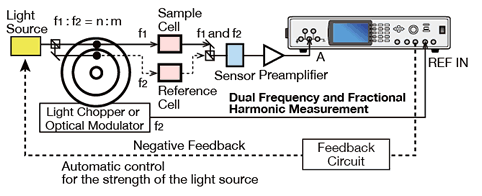 |
| Using both the dual-frequency simultaneous and fractional harmonic measurement functions allows fluctuation corrections of light sources and other sources using the dual beam method (ratio measurement) with a single LI5660/ LI5655/LI5650. Applying negative feedback to the reference cell signal also stabilizes the strength of the light source. The integral multiple (n x), integral inverse (1/m x) and fraction (n/m x) of the reference signal frequency can be configured, allowing it to be used easily with light chopper frequency ratios. When integral ratios are used, signals cannot be distinguished from harmonic components generated by distortion in the signal, however there is no impact on the harmonics if fraction ratios are used. The 10 MHz synchronization function can also be used to synchronize operation with external signal generators, allowing detection of any two frequencies. |
Hall Coefficient Measurement (Difference Frequency Measurement) 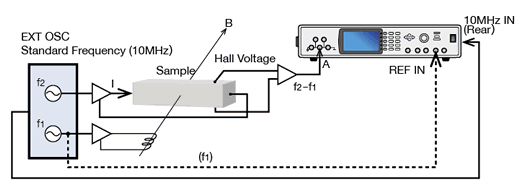 |
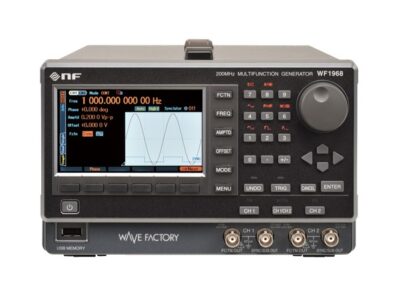
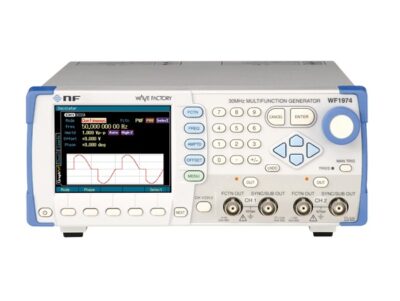
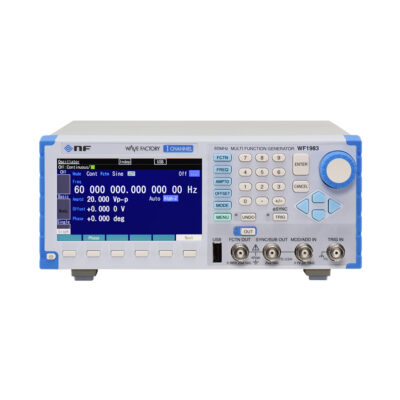
| The hall voltage is proportional to the product of two signals (current and magnetic field), and its frequency is the difference frequency (and sum) of the two signals. Synchronizing an external signal source, which generates a current and magnetic field, with the LI5600 series at an external 10 MHz allows measurement of the difference frequency signal of any two frequencies without having to arrange an external reference signal (difference frequency). (when used with a signal generator with a 2-channel output and frequency reference output) If the original frequency is a integral* ratio, the fractional harmonic measurement function can also be used to measure the difference frequency signal. Either method avoids crosstalk interference from the external reference signal. |
Other applications
• Spectroscopy (material science using Auger electron spectroscopy, photoacoustic spectroscopy, Raman spectroscopy, etc.) • Measurement of optical properties (intensity, absorption, scattering, transmission, etc.) • Optical application measurements (optical gyro, detection of distance, speed, vibration, etc.) • Magnetic measurements (evaluation of magnetic materials, vibration-type magnetometer, magnetic detection using SQUID) • Evaluation of various sensors (measurements of physical quantities detected by optical, magnetic, and piezoelectric elements, chemical changes, etc.) • Null detection with impedance bridge • Impedance measurements (minute impedance, minute capacity, chemical impedance) • Thermal diffusivity measurement of thin film materials • Inelastic Electron Tunneling Spectroscopy (IETS Methos) • Measurement of TMR (Tunnel Magneto Resistance Effect)