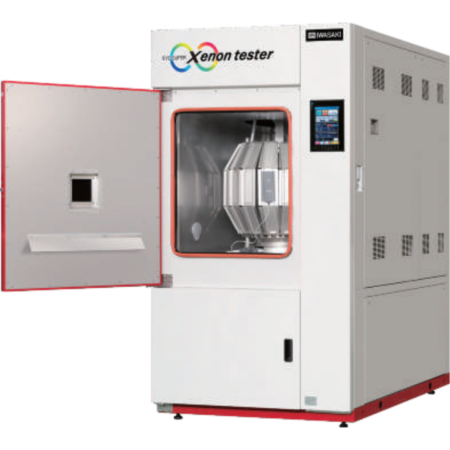
IWASAKI XER-W85 EYE Super Xenon Tester
High-intensity xenon weathering system with automatic irradiance control from 60 to 180 W/m² over the 300–400 nm measurement range for controlled accelerated weathering evaluation.
View XER-W85Xenon · High-Intensity UV · Weatherometer · Material Durability
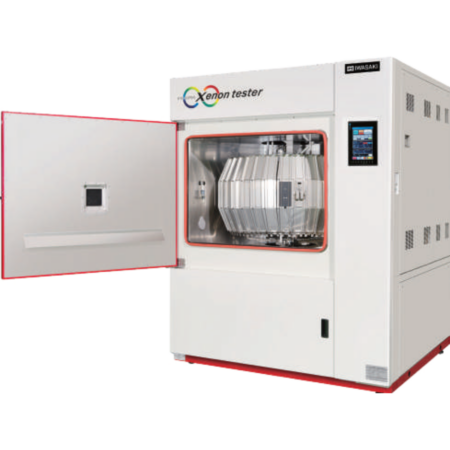
Explore IWASAKI accelerated weathering testers and environmental chambers for xenon arc exposure, high-intensity UV testing, solar radiation simulation, and material durability evaluation.
Start with the material, degradation mechanism, applicable standard, required acceleration level, sample capacity, and environmental conditions. Then select the weathering method that best matches the test objective.
FIND YOUR TEST APPROACH
Compare xenon weathering, high-intensity UV acceleration, and standards-based solar simulation for your test objective.
Xenon arc accelerated weathering
Evaluate material durability with xenon arc exposure designed to reproduce sunlight-related degradation under controlled irradiance, temperature, humidity, spray, and dark-cycle conditions.
Recommended for this test approach
High-intensity xenon weathering system with automatic irradiance control from 60 to 180 W/m² over the 300–400 nm measurement range for controlled accelerated weathering evaluation.
View XER-W85
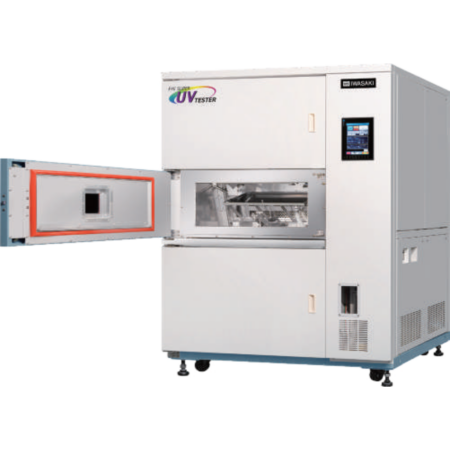
Flexible xenon weathering platform supporting standard, medium-, and high-intensity irradiation workflows with temperature, humidity, spray, and dark-cycle control.
View XER-W83-AMetal-halide UV accelerated weathering
Accelerate UV-driven degradation studies using high-intensity metal-halide exposure for research, development, screening, and material durability evaluation.
Recommended for this test approach
High-intensity metal-halide UV weathering tester with irradiation up to 150 mW/cm² and controlled irradiation, condensation, darkness, and shower conditions.
View SUV-W171Weathering method and test-plan selection
Compare xenon arc, high-intensity UV, and solar-simulation methods for your material or component. Confirm the required standard, exposure cycle, irradiance, temperature, humidity, and equipment configuration before selecting a weathering system.
Recommended for this test approach
Suitable when xenon exposure, broad standards coverage, multiple irradiance levels, and controlled environmental cycling are central to the test requirement.
View XER-W83-A
Suitable for modern xenon weathering workflows requiring high-intensity capability, a reduced footprint, and repeatable controlled exposure.
View XER-W85
Suitable when rapid UV-driven degradation screening and high acceleration are more important than reproducing the full solar spectrum.
View SUV-W171
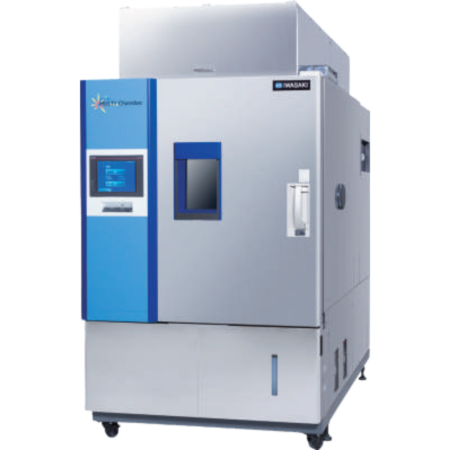
Solar radiation and combined environmental testing for materials and components, including small specimens when suitable fixtures and test conditions are specified. The relevant model supports DIN 75220, MIL-STD-810G/H, and IEC 60068-2-5; confirm the exact configuration.
View 4D MULTI ChamberWeathering Test Selection
Select the light source and exposure cycle that match the required degradation mechanism and test method. Check the applicable standard, specimen mounting, acceleration level, sample capacity, and environmental conditions for each system.
Weathering test applications
Accelerated weathering tests expose materials to controlled light and environmental conditions to evaluate changes such as color shift, gloss loss, cracking, and reduced mechanical performance. Select the exposure method according to the expected failure mode and the customer's test specification.
Evaluate interior and exterior plastics, coatings, and parts under the light and environmental cycles required by the applicable automotive specification.
Compare color, gloss, and surface changes after controlled xenon arc or high-intensity UV exposure. Confirm the test method before comparing results across instruments.
Assess the durability of exterior finishes, plastics, and other exposed materials using appropriate irradiation, moisture, and temperature cycles.
Use a suitable EYE 4D MULTI Chamber configuration for solar irradiation combined with environmental conditions. Small specimens may also be tested when mounting and exposure requirements are met.
Exposure methods
These approaches use different light sources and exposure conditions. Test duration alone does not establish equivalence with outdoor exposure; use the method specified by the applicable standard or test plan.
XER-W83-A and XER-W85 support controlled xenon arc exposure for material weathering programs. Select filters, irradiance, moisture cycles, and other options against the required method.
SUV-W171 uses metal-halide UV exposure for accelerated screening of UV-driven changes. Its exposure is different from a full-spectrum xenon or solar simulation test.
EYE 4D MULTI Chamber combines light exposure with controlled environmental conditions. Confirm the solar irradiation model, fixture, specimen positioning, and required test cycle.
Document the wavelength range, irradiance measurement, temperature, humidity, spray or dark cycles, and evaluation criteria when comparing test programs.
How to select
Start with the exact revision of the customer or industry method. Standards may require specific filters, cycles, fixtures, or optional equipment; a listed standard does not mean every configuration satisfies every condition.
| Selection factor | What to confirm | Relevant approach |
|---|---|---|
| Light source | Required spectrum, irradiance, measurement wavelength, and exposure cycle | XER xenon arc, SUV metal-halide UV, or 4D MULTI solar irradiation model |
| Test standard | Exact method, revision, exposure conditions, and optional configuration | XER for applicable ASTM/ISO/JIS methods; confirm 4D MULTI configuration for DIN 75220, MIL-STD-810G/H, or IEC 60068-2-5 |
| Specimen and capacity | Dimensions, number of samples, mounting angle, and exposure uniformity | All systems: verify the available holder or fixture, including small specimens in 4D MULTI |
| Environmental cycle | Temperature, humidity, condensation, spray, darkness, and required sequence | Choose the system and options that can reproduce the specified conditions |
| Test objective | Material screening, standards-based evaluation, or component-level environmental testing | Match the method to the failure mode and reporting requirements |
Frequently asked questions
Xenon arc and metal-halide UV systems use different light sources and exposure conditions. Select the method required by the standard and the degradation mechanism under evaluation; their test durations and results should not be treated as directly interchangeable.
Small specimens can be considered when the selected model, mounting fixtures, exposure position, and test conditions are suitable. Share the specimen dimensions and required standard to confirm the configuration.
The solar irradiation model is described by IWASAKI for DIN 75220, MIL-STD-810G/H, and IEC 60068-2-5 applications. Confirm the exact model, standard revision, and required conditions before specifying compliance for a test program.
Compare the required light source and standard first, then irradiance, sample capacity, exposure cycle, and available options. XER models provide xenon arc testing; SUV-W171 provides high-intensity metal-halide UV testing.
Provide the material, specimen size and quantity, exact test standard and revision, irradiance and wavelength requirements, temperature and humidity conditions, spray or dark cycles, and desired throughput.
Application support
Share your material, test standard, exposure conditions, and specimen requirements. Denkei Americas can help identify an IWASAKI system and suitable configuration.
Discuss Your Test Requirements