


50 MHz and 80 MHz Arbitrary Waveform and Function Generation
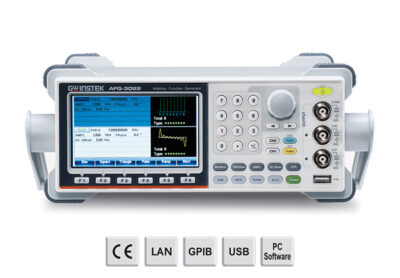
The GW Instek AFG-3000 Series combines up to 80 MHz signal generation with 200 MSa/s arbitrary waveform sampling, 16-bit amplitude resolution and 1 million points of waveform memory.
The series includes two models: AFG-3051 with a 50 MHz sine-wave frequency range and AFG-3081 with an 80 MHz range. Both provide standard function waveforms and arbitrary waveform editing for electronic circuit design, validation and laboratory testing.
80 MHz
Maximum frequency on AFG-3081
200 MSa/s
Arbitrary waveform sampling rate
16-bit
Amplitude resolution
1M Points
Arbitrary waveform length
Waveforms can be created through front-panel editing, CSV import or PC software. The Direct Waveform Reconstruction (DWR) function also supports importing compatible oscilloscope waveforms for subsequent modification and signal output.
A 4.3-inch color display, switchable 50-ohm and high-impedance load settings, and USB, RS-232 and GPIB interfaces support both manual laboratory operation and computer-controlled measurements.
50 MHz and 80 MHz Model Options
Choose the 50 MHz AFG-3051 or 80 MHz AFG-3081 according to the required signal frequency range.
200 MSa/s Arbitrary Sampling
Generates user-defined arbitrary waveforms with a 200 MSa/s sampling rate and 16-bit amplitude resolution.
1-Million-Point Waveform Memory
Supports long arbitrary waveform records and selectable output sections for flexible signal generation.
Multiple Waveform Editing Methods
Create or modify waveforms using front-panel controls, CSV files, PC software or compatible oscilloscope waveform imports.
Direct Waveform Reconstruction
Imports supported waveform data from compatible GW Instek oscilloscopes for editing and reproduction.
Remote Control Interfaces
Provides USB, RS-232 and GPIB interfaces with a 4.3-inch TFT display and built-in operating help.
Electronic Circuit Development
Generate standard and custom waveforms for evaluating analog and digital electronic circuits.
Signal Response Testing
Apply controlled input signals to study circuit response, signal conditioning and filtering behavior.
Arbitrary Waveform Simulation
Reproduce user-defined signal patterns for experimental verification and troubleshooting.
Oscilloscope Waveform Reconstruction
Import and edit compatible captured oscilloscope waveforms for repeated test scenarios.
Automated Electronic Testing
Control waveform generation remotely through supported computer communication interfaces.
Research and Engineering Education
Generate repeatable signals for laboratory experiments, instrument training and electronic research.
| Specification | AFG-3051 | AFG-3081 |
|---|---|---|
| Maximum Sine Frequency | 50 MHz | 80 MHz |
| Frequency Resolution | 1 µHz | 1 µHz |
| Arbitrary Waveform Sampling Rate | 200 MSa/s | 200 MSa/s |
| Amplitude Resolution | 16 bits | 16 bits |
| Maximum Waveform Length | 1M points | 1M points |
| Nonvolatile Waveform Memory | 10 × 1M-point waveforms | 10 × 1M-point waveforms |
| Arbitrary Output Section | 2 to 1M points | 2 to 1M points |
| Frequency Stability | ±1 ppm over 0–50°C | ±1 ppm over 0–50°C |
| Output Amplitude into 50 Ω | 10 mVpp to 10 Vpp | 10 mVpp to 10 Vpp |
| Output Amplitude Open Circuit | 20 mVpp to 20 Vpp | 20 mVpp to 20 Vpp |
| Output Load Setting | 50 Ω / High-Z | 50 Ω / High-Z |
| Standard Waveforms | Sine, Square, Ramp, Pulse, Noise, DC and other built-in waveforms | Sine, Square, Ramp, Pulse, Noise, DC and other built-in waveforms |
| Waveform Editing | Front panel, CSV, PC software, DWR | Front panel, CSV, PC software, DWR |
| Display | 4.3-inch TFT LCD | 4.3-inch TFT LCD |
| Remote Interfaces | USB, RS-232, GPIB | USB, RS-232, GPIB |
Specifications are based on GW Instek's AFG-3051 / AFG-3081 documentation. The 50 MHz and 80 MHz ratings refer to the sine-wave frequency ranges; maximum frequencies vary by waveform type. The 50 Ω / High-Z selection is a load-setting function and does not indicate that the physical output impedance changes. Confirm output amplitude limits and required interfaces for the intended application.