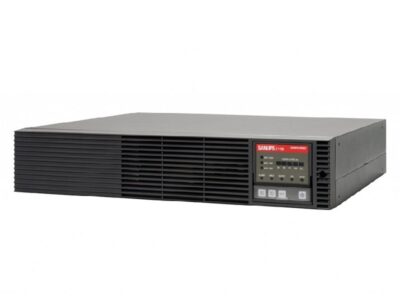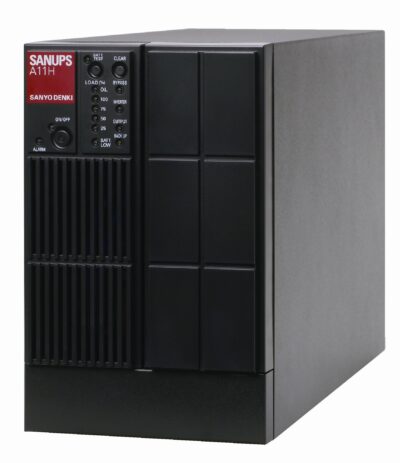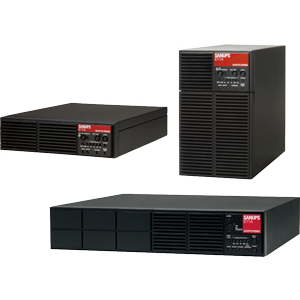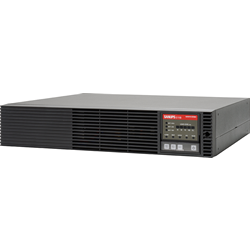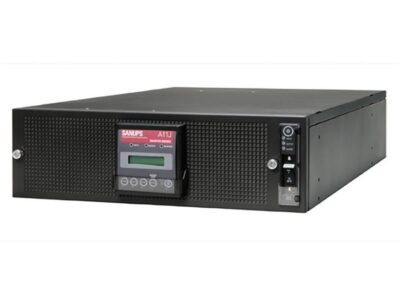


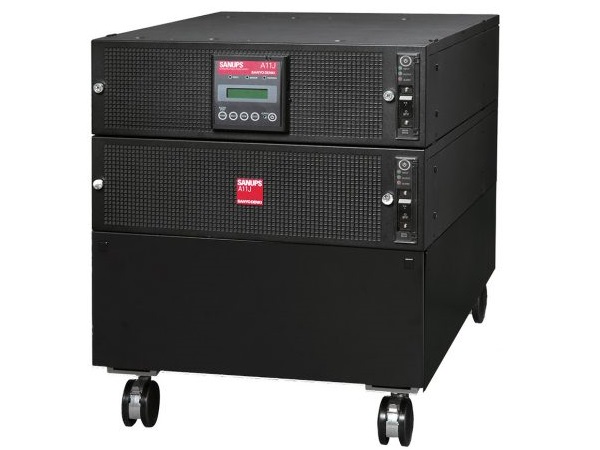

SANYO DENKI SANUPS A11J-S2 Redundant Online UPS
Modular N+1 redundant true-online UPS platform for mission-critical loads that require higher availability and maintenance flexibility.
The SANYO DENKI SANUPS A11J-S2 Redundant Type is a double-conversion online UPS platform engineered for reliability-sensitive industrial and IT applications. Parallel modules can be configured to share load and provide spare conversion capacity, reducing the risk of outage from a single module failure when correctly specified.
The manufacturer U.S. lineup describes 5, 10, 15 and 20 kVA configurations with output power factor 0.9. Total installed UPS nameplate capacity and usable capacity with N+1 redundancy are not equivalent; the redundant system must reserve enough capacity to carry the load if one module is unavailable.
Plug-in battery and power-conversion modules and service-oriented cabinet design can make maintenance more practical. Whether work can proceed without disrupting the protected load depends on appropriate bypass arrangements, a properly sized redundant configuration and qualified service procedures. Verify power distribution, battery autonomy and current local ordering variants before quoting.
N+1Redundancy with correctly sized spare capacity
5–20 kVAManufacturer U.S. configuration lineup
0.9 PFPublished output power factor
ModularServiceable battery and inverter architecture
N+1 Redundant Operation
Reserve capacity to continue supplying the load following one module fault.
Parallel Capacity Scaling
Configure modular units according to load and future demand.
True Online Power Quality
Double conversion supports conditioned supply to critical equipment.
0.9 Output Power Factor
Supports modern high power-factor industrial and IT loads.
Front-Serviceable Modules
Modular power and battery components support planned maintenance.
Battery and System Diagnostics
Monitoring functions help maintain readiness and identify service needs.
Data Center Power Protection
Increase availability for critical IT racks and network systems.
Semiconductor Manufacturing Equipment
Protect inspection and production electronics.
Industrial Automation Infrastructure
Support high-availability controllers and communications.
Rail and Signaling Systems
Provide continuity for appropriately sized rail-control electronics.
Factory Process Monitoring
Maintain control and instrumentation power during supply events.
Critical Laboratory Systems
Support research and analysis equipment requiring continuous operation.
| U.S. lineup capacity | 5 kVA | 10 kVA | 15 kVA | 20 kVA |
|---|---|---|---|---|
| Rated active output at 0.9 PF | 4.5 kW | 9 kW | 13.5 kW | 18 kW |
| N+1 capacity | Configuration-dependent | Configuration-dependent | Configuration-dependent | Configuration-dependent |
| Specification | Details |
|---|---|
| UPS architecture | Parallel modular double-conversion online UPS |
| Operating concept | N+1 redundancy where the system is configured with spare module capacity |
| Output power factor | 0.9 |
| Manufacturer U.S. lineup | 5, 10, 15, 20 kVA listed |
| Nominal U.S. operating voltage | Manufacturer U.S. lineup describes 208 V; settings 200/208/220/230/240 V on applicable models |
| Efficiency | Up to ~93% under manufacturer-described conditions; varies by model and load |
| Battery health management | Automatic health-check and status features available |
| Maintenance | Modular inverter and battery service; follow applicable bypass, redundancy and safety procedures |
The cited 5–20 kVA figures are product-line configurations, not guaranteed N+1 load ratings. The net protected load in a redundant design must remain within the capacity of all remaining modules after one is lost. System sizing, number of modules, input/output voltage, battery autonomy, maintenance bypass, approvals and actual N+1 output should be confirmed for the exact cabinet and site.